Finding a China top industrial warehouse fan supplier requires more than comparing catalog prices. Warehouse airflow affects heat control, worker comfort, dust movement, and equipment reliability. The International Energy Agency’s The Future of Cooling report warns that cooling demand could more than triple worldwide by 2050. That pressure makes efficient ventilation increasingly important.
Market estimates vary widely. Fortune Business Insights and Grand View Research both identify industrial fans as a growing equipment sector, but their figures use different product definitions. This matters. A supplier may advertise impressive airflow while omitting noise, motor efficiency, duty cycle, or tested operating conditions. Buyers should request performance curves, motor data, factory inspection records, and independent test evidence.
A qualified industrial warehouse fan manufacturer should understand large-span buildings, roof height, air stratification, and seasonal ventilation needs. Standards from AMCA and ASHRAE provide useful reference points for fan testing and indoor comfort. ISO 9001 certification can support process consistency, though it does not guarantee every product’s performance. Details matter: a fan turning above a loading dock should not create dangerous drafts, while a unit above stacked cartons must operate quietly and reliably.
No supplier is automatically “top.” That judgment needs evidence. I would examine installation photos, measured airflow, warranty terms, spare-part access, and customer feedback from comparable warehouses. A low quotation may conceal weak testing or limited after-sales support. This review remains cautious because published supplier data is not always independently verified. The strongest Chinese supplier combines engineering experience, transparent documentation, stable production, and practical support after delivery.
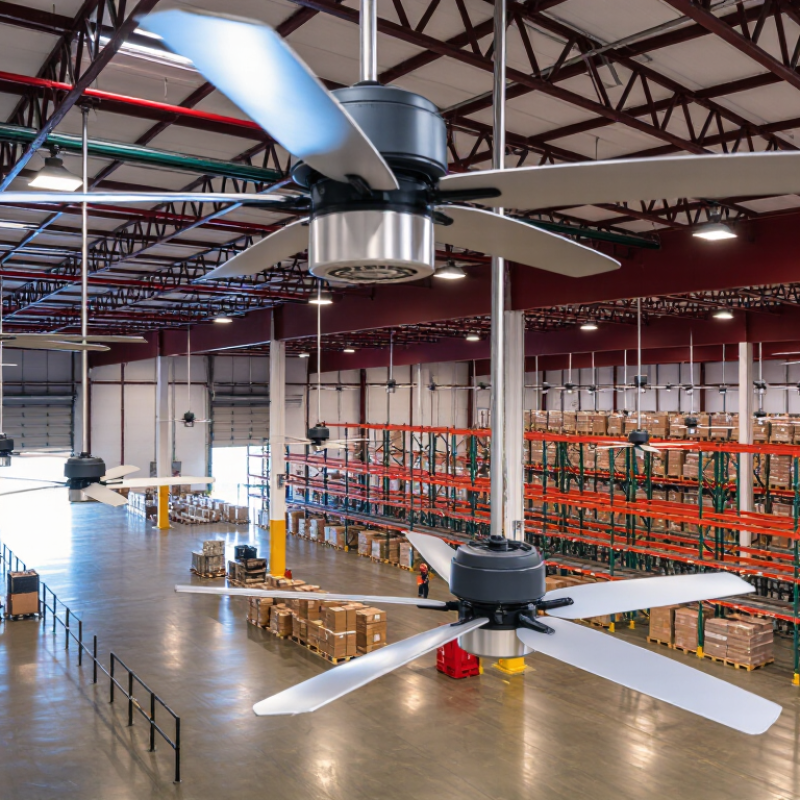
China Top Industrial Warehouse Fan Supplier?
Industrial warehouse fans are large air-movement systems designed for high-ceiling buildings. They circulate substantial air volumes at relatively low speed, improving comfort without relying only on air conditioning. Their main functions include destratification, moisture control, heat removal, and ventilation support. In a 12-meter warehouse, warm air can collect near the roof while workers remain in cooler zones. Properly selected fans push this trapped heat downward and reduce temperature differences across the workspace.
Air movement matters. According to the International Energy Agency’s Buildings report, buildings consume about 30% of global final energy. Efficient air circulation can therefore support lower cooling demand, although fan performance depends on layout, controls, and maintenance. The U.S. Department of Energy also identifies fan systems as important industrial energy users, making motor efficiency and variable-speed control practical evaluation points. Noise, lighting, sprinklers, and storage racks must be checked before installation.
Applications include logistics centers, manufacturing plants, agricultural buildings, sports halls, and loading areas. In practice, installers should measure ceiling height, aisle direction, worker density, and local heat sources. One mistake is treating every warehouse as identical. A fan may improve comfort near one workstation while creating drafts elsewhere. ASHRAE Standard 55 provides useful thermal-comfort guidance, but real buildings still require on-site testing. Dust accumulation, unbalanced blades, and poor control settings can quietly reduce performance. That detail is easy to overlook.
Industrial warehouse fans are large air-circulation systems designed to move air across wide indoor spaces. The chart shows representative air-speed ranges commonly used for destratification, occupied storage areas, work zones, loading docks, and spot cooling. Actual design values depend on building height, occupancy, heat load, ventilation requirements, and local regulations.
Air-speed values are shown in metres per second (m/s) and represent practical engineering ranges rather than mandatory limits.
Why China Is a Major Source of Industrial Warehouse Fans
China’s strength begins with manufacturing depth. UNIDO’s 2024 Industrial Development Report places China at roughly one-third of global manufacturing value added. That scale supports motors, steel housings, controllers, bearings, and packaging within one supply network. Shorter supply routes can reduce delays. Usually.
General Administration of Customs data show mechanical and electrical products represented 58.6% of China’s exports in 2023. This broad electrical manufacturing base supports competitive warehouse fan production. The IEA reports that electric motor systems consume around half of global electricity. Therefore, motor efficiency deserves more attention than a low purchase price. Buyers should request measured airflow, power input, noise levels, duty-cycle testing, and protection ratings. A fan that moves air well but wastes energy is not truly economical.
Factory capability still varies. Some suppliers have strong engineering teams, while others mainly assemble imported parts. This is where practical verification matters. Review test records, material thickness, motor certificates, coating quality, and spare-parts policies. Ask for a sample under realistic warehouse conditions, including dust, heat, and long operating hours. Independent inspection can expose weak welds or inaccurate performance claims. Reports from market researchers often forecast steady industrial fan growth, but forecasts cannot replace site testing. China offers broad choice and scalable production, yet supplier selection still requires careful technical judgment.
How to Evaluate China’s Top Industrial Warehouse Fan Suppliers
Evaluating a leading China-based warehouse fan supplier requires more than comparing catalog prices. The U.S. Department of Energy’s fan-system guidance states that fans can consume up to 20% of industrial electricity. Therefore, request tested airflow, input power, efficiency, and noise data at the same operating point. A large fan moving air at low wattage deserves closer attention. Check whether measurements follow recognized standards, such as AMCA 230 or ISO 13349. Do not accept vague claims like “energy-saving” without test conditions.
Inspect the factory’s production controls, motor sourcing, balancing process, and final inspection records. ISO 9001 certification helps, but it does not replace product testing. Ask for traceable serial numbers, warranty terms, spare-part availability, and response times for remote troubleshooting. The International Energy Agency’s Energy Efficiency Market Report highlights the importance of measurable efficiency improvements, not marketing language. Supplier audits should include a running test on a warehouse floor, where dust, steel racks, and uneven air paths affect performance. Small details matter.
A weakness remains.
Some suppliers provide excellent engineering documents but weak after-sales support. Others respond quickly but offer incomplete performance curves. Compare at least three suppliers using identical airflow, ceiling height, duty cycle, and electricity-price assumptions. Record every answer. A cheaper quotation may become expensive after installation, control integration, or motor replacement.
| Evaluation Area | Key Data Dimension | Recommended Evaluation Benchmark | Evidence to Request | Suggested Weight |
|---|---|---|---|---|
| Product Configuration | Fan diameter and application type | Product range should cover the required warehouse height, floor area, and operating environment. Large-diameter ceiling fans are commonly selected for high-bay spaces, while smaller units suit localized air circulation. | Dimension drawings, installation-height guidance, layout proposal, and application references without undisclosed claims. | 10% |
| Airflow Performance | Air volume, coverage, and air velocity | Compare airflow using the same measurement method and operating speed. Do not evaluate suppliers only by motor power or maximum claimed coverage. | Complete performance curves, test conditions, measurement location, airflow units, and recommended fan spacing. | 15% |
| Energy Efficiency | Motor efficiency and operating power | Request input power at several speed settings and compare airflow per watt. Variable-speed operation is valuable where ventilation demand changes during the day. | Rated-power sheet, measured wattage, motor efficiency data, speed-control specifications, and annual energy estimate. | 15% |
| Electrical Compatibility | Voltage, frequency, phase, and controller compatibility | The proposed electrical configuration must match the destination country and site supply. Confirm whether the controller requires single-phase or three-phase input. | Nameplate, wiring diagram, controller manual, voltage range, frequency, phase, current, and protection requirements. | 10% |
| Safety and Compliance | Guarding, structural safety, electrical safety, and market compliance | Safety documentation must correspond to the exact model, motor, controller, and destination market. Certification logos alone are not sufficient proof. | Risk assessment, test reports, declarations of conformity where applicable, installation instructions, and safety inspection records. | 15% |
| Durability | Materials, corrosion resistance, bearings, and service life | Construction should match the site conditions, including dust, humidity, temperature, corrosive chemicals, and cleaning methods. | Material specifications, coating details, bearing information, environmental limits, endurance-test records, and maintenance schedule. | 10% |
| Noise and Comfort | Sound pressure level and vibration control | Noise data should state the distance, room condition, fan speed, and measurement method. Compare products under equivalent test conditions. | Noise-test report, vibration limits, balancing procedure, suspension details, and recommended operating speed. | 8% |
| Manufacturing Quality | Quality-management process and traceability | Prefer suppliers that use documented incoming inspection, in-process checks, final testing, serial-number traceability, and corrective-action procedures. | Quality certificate, inspection plan, sample inspection records, calibration records, production photos, and third-party factory audit results. | 10% |
| Installation and Service | Installation support, spare parts, and warranty terms | A qualified supplier should provide clear installation procedures, commissioning support, spare-parts availability, and written warranty exclusions. | Installation manual, training plan, spare-parts list, response-time commitment, warranty document, and service contacts. | 10% |
| Commercial Reliability | Quotation clarity, lead time, payment terms, and delivery control | The quotation should identify the complete system, including fan, controller, mounting hardware, packaging, testing, shipping terms, and taxes where applicable. | Itemized quotation, production lead time, approved drawings, packaging specification, inspection plan, and shipment schedule. | 5% |
| Total Evaluation Weight | 100% | |||
Evaluation note: Technical values should be compared only when the test conditions, measurement methods, fan configuration, and operating speed are equivalent. Final selection should also consider local electrical codes, building requirements, and a verified site layout.
A capable supplier should prove airflow, safety, and production consistency, not only show attractive photographs. The UNEP Global Status Report for Buildings and Construction 2023 states that buildings and construction consumed about 34% of global energy and produced around 37% of energy-related emissions in 2022. Efficient air movement matters.
For a warehouse, request measured airflow, power input, noise level, and coverage at worker height. A fan moving air above storage racks may perform poorly on the floor.
Key products should include high-volume low-speed fans, variable-speed controls, protective guards, and corrosion-resistant finishes. Check motor efficiency, bearing life, blade balance, and emergency-stop design. AMCA 230 provides a recognized method for evaluating air-circulating fan performance. Test reports should identify room size, instruments, operating speed, and uncertainty. Missing details deserve questions.
Manufacturing evidence is equally important.
Look for incoming-material inspection, welded-frame checks, dynamic balancing, electrical safety testing, and serial-number traceability. ISO 9001 supports controlled quality processes, while ISO 14001 addresses environmental management. IEC 60034 is relevant to rotating electrical machines, but certification scope must match the actual motor and market. CE marking may apply in Europe; other destinations require different conformity procedures.
A certificate alone proves little. Ask for current reports from accredited laboratories, calibration records, and a sample inspection plan.
I would also verify low-speed vibration after installation. This step is often overlooked. A careful supplier should discuss failures openly, because warehouse conditions are rarely as clean as factory test rooms.
Choosing an industrial warehouse fan supplier requires more than comparing prices. Check airflow data, motor efficiency, noise levels, and warranty terms. Ask for performance records from warehouses with similar ceiling heights and dust conditions. A reliable supplier should explain coverage areas clearly, without hiding behind vague technical language. Request drawings, load information, and replacement-part availability before placing an order.
Installation quality affects every later result. Confirm roof structure, power requirements, lifting access, and control-system compatibility with an experienced technician. During a site visit, measure ceiling height and aisle layout, not only floor area. I once saw a fan positioned too close to stored goods. It worked, but airflow became uneven. That small mistake increased operating complaints. Supplier service should include commissioning, safety checks, maintenance guidance, and a reachable response process. Written records matter when problems appear months later.
Tips: Compare actual airflow, not advertised size. Ask for a detailed installation schedule. Keep spare controllers and essential parts available. Test vibration after installation. Inspect wiring carefully. Do not assume every warehouse needs the same fan arrangement. A practical supplier will welcome questions, admit limitations, and adjust recommendations when site conditions change. That honesty is often more valuable than a polished sales presentation.
China has deep manufacturing capacity for motors, steel housings, controllers, bearings, and packaging. These parts often come from one supply network. Shorter routes may reduce delays. Usually.
Request measured airflow, power input, noise levels, duty-cycle results, and protection ratings. Ask for the testing conditions and operating point. A low price proves little.
Electric motor systems use a large share of global electricity. An efficient fan can reduce operating costs over many years. Check watts against delivered airflow. Cheap is not always economical.
Use identical airflow, ceiling height, duty cycle, and electricity-price assumptions. Compare at least three suppliers. Record every answer. Memory is unreliable.
Review motor sourcing, production controls, balancing procedures, material thickness, coating quality, and final inspection records. Check welds carefully. Weak details can cause later failures.
Yes. Test the fan under realistic warehouse conditions, including dust, heat, steel racks, and long operating hours. Uneven air paths matter. Catalog results may not match the floor.
Request traceable serial numbers, test records, warranty terms, spare-parts policies, and remote troubleshooting response times. Certification helps, but it does not replace product testing. Support can be incomplete.
Be cautious about vague “energy-saving” claims without test conditions or performance curves. Check whether the supplier mainly assembles imported parts. Independent inspection can reveal weak welds or inaccurate claims. My judgment could still be wrong.
An industrial warehouse fan is a large air-movement system designed to improve ventilation, temperature balance, and working comfort in expansive facilities. It can support heat removal, moisture reduction, air circulation, and energy-efficient climate management in warehouses, workshops, logistics centers, agricultural buildings, and other industrial spaces. China has become a major source of these products because of its broad manufacturing capacity, adaptable production lines, competitive supply chains, and experience serving diverse international requirements.
When evaluating China’s top industrial warehouse fan suppliers, buyers should consider airflow performance, motor efficiency, noise levels, safety design, durability, customization options, and quality-control procedures. Attention should also be given to product materials, manufacturing consistency, testing systems, and applicable electrical, mechanical, and safety certifications. A reliable purchasing decision should include clear technical specifications, transparent quotations, production lead times, warranty terms, spare-parts availability, installation guidance, and after-sales support. Proper site assessment and professional installation are essential to ensure efficient operation, safe use, and long-term value.

Liangzhi Electrical