Choosing reliable warehouse fans in China requires more than comparing catalog photos and advertised airflow. Buyers must examine motor efficiency, blade balance, noise levels, safety features, warranty terms, and long-term service support. A powerful fan may move air effectively, yet still create excessive noise or consume unnecessary energy. Real warehouse conditions matter.
This guide introduces ten leading Chinese warehouse fan manufacturers for industrial, commercial, and logistics applications. The selection considers manufacturing experience, product range, quality systems, export capability, customization options, and customer feedback. It also reflects practical concerns seen in large facilities, such as dusty floors, high ceilings, narrow aisles, and uneven ventilation. Some manufacturers focus on high-volume industrial fans, while others provide compact units for workshops and loading areas.
The ranking is not absolute. Market positions can change quickly. A company with strong production capacity may not offer the best after-sales support in every region. Product performance can also vary between models. Therefore, buyers should request current specifications, test reports, installation guidance, and maintenance details before placing an order. Check the warranty carefully. Confirm the motor rating, airflow coverage, control method, and available spare parts.
This overview aims to support a more informed supplier comparison. It does not replace on-site ventilation planning or professional engineering advice. When the right manufacturer matches the right building, warehouse fans can improve air circulation, worker comfort, and operational reliability. Mistakes still happen. Careful verification remains essential.
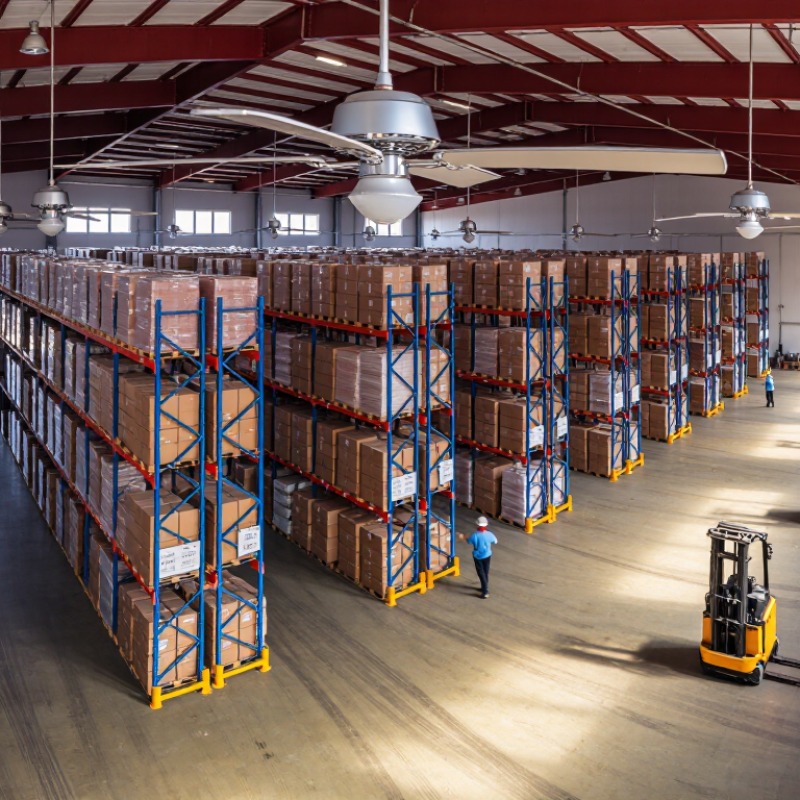
Defining the Selection Criteria for China’s Warehouse Fan Manufacturers
Defining the Selection Criteria for China’s Warehouse Fan Manufacturers
Selecting China’s top ten warehouse fan manufacturers requires more than comparing factory prices. Product performance should come first. The UNEP 2023 Global Status Report states that buildings consumed about 34% of global energy in 2022. They also produced approximately 37% of energy and process-related carbon emissions. These figures make motor efficiency, airflow stability, and control accuracy important purchasing criteria. A suitable manufacturer should provide tested airflow data, sound levels, power consumption, and working-temperature limits.
Factory verification matters just as much.
Buyers should inspect production lines, motor testing equipment, welding quality, and final inspection records. ISO 9001 certification can support process reliability, but it cannot replace physical audits. Ask for test reports linked to recognized standards, such as ISO 5801 for fan performance. Check whether the reported cubic metres per hour match independent measurements. Numbers can look perfect on paper.
After-sales capability is often underestimated. Spare motors, controllers, bearings, and installation guidance should remain available for years. A practical assessment should review response times, warranty exclusions, packaging strength, and export experience. Energy savings also deserve calculation under real operating conditions, not only at maximum speed. A low purchase price may hide higher electricity and maintenance costs. That is an easy mistake. Even experienced buyers may overvalue certificates while overlooking airflow distribution across a crowded warehouse.
Comparing the Top 10 Warehouse Fan Manufacturers in China
Comparing the top 10 warehouse fan manufacturers in China requires more than checking catalog prices. A reliable comparison begins with airflow, motor efficiency, blade balance, and production consistency. In a real warehouse, dust, high ceilings, and narrow aisles can expose weak design quickly. A fan that looks powerful in a showroom may circulate air poorly around storage racks.
The strongest manufacturers usually provide measured airflow data, noise readings, motor specifications, and installation guidance. Their factories should support quality inspections, sample testing, and traceable component records. Warranty terms also matter, especially for fans operating eight or more hours daily. Some suppliers offer customized diameters, control systems, and corrosion-resistant finishes. However, customization may increase delivery time and maintenance complexity.
Price comparisons can be misleading. A lower quotation may exclude controllers, mounting hardware, testing, or after-sales support. Performance can also vary between a tested sample and a large production batch. I would request independent test reports and inspect at least one installed project. Quiet operation is valuable, but it does not always mean stronger circulation. Energy labels deserve attention too, although actual consumption depends on speed settings and building conditions. The top ten should therefore be compared through documented performance, factory capability, service response, and long-term operating value, not marketing language alone.
What Are the Top 10 Warehouse Fan Manufacturers in China? - Comparing the Top 10 Warehouse Fan Manufacturers in China
| Rank |
Anonymous Manufacturer Profile |
Primary Warehouse Fan Types |
Common Fan Diameter |
Typical Airflow Range |
Motor Options |
Common Certifications |
Typical Production Lead Time |
Typical MOQ |
Typical Export Markets |
Best-Fit Buyer |
| 1 |
Profile A |
HVLS ceiling fans and industrial exhaust fans |
3.0–7.3 m |
45,000–150,000 m³/h |
Permanent-magnet and induction |
CE, ISO 9001 |
15–30 days |
1–5 units |
Europe, North America, Southeast Asia |
Large logistics facilities |
| 2 |
Profile B |
HVLS fans and wall-mounted axial fans |
3.6–7.3 m |
40,000–145,000 m³/h |
Induction and EC motor options |
CE, RoHS, ISO 9001 |
20–35 days |
2–10 units |
Middle East, Australia, Africa |
Factories and distribution centers |
| 3 |
Profile C |
Industrial HVLS fans and portable air circulators |
3.0–6.1 m |
35,000–125,000 m³/h |
Permanent-magnet motor |
CE, EMC, ISO 9001 |
18–30 days |
1–5 units |
North America, Europe, Latin America |
Energy-conscious warehouses |
| 4 |
Profile D |
Axial flow fans and evaporative cooling fans |
500–1,400 mm |
10,000–55,000 m³/h |
Three-phase induction |
CE, ISO 9001 |
15–25 days |
10–20 units |
Southeast Asia, Africa, South America |
Ventilation contractors |
| 5 |
Profile E |
HVLS fans and low-noise warehouse fans |
4.2–7.3 m |
50,000–150,000 m³/h |
Permanent-magnet motor |
CE, RoHS, ISO 9001 |
25–40 days |
1–3 units |
Europe, Japan, South Korea |
Temperature-sensitive storage |
| 6 |
Profile F |
Industrial exhaust fans and roof ventilators |
500–1,380 mm |
12,000–60,000 m³/h |
Induction motor |
CE, ISO 9001 |
15–30 days |
10–50 units |
Southeast Asia, Middle East, Africa |
Cost-focused projects |
| 7 |
Profile G |
Large ceiling fans and customized ventilation systems |
3.6–7.3 m |
40,000–145,000 m³/h |
Permanent-magnet and induction |
CE, EMC, ISO 9001 |
25–45 days |
1–5 units |
North America, Europe, Australia |
OEM and project buyers |
| 8 |
Profile H |
Portable industrial fans and high-velocity fans |
300–750 mm |
5,000–28,000 m³/h |
Single-phase and three-phase induction |
CE, RoHS |
10–20 days |
20–100 units |
Africa, Southeast Asia, Latin America |
Small and medium warehouses |
| 9 |
Profile I |
Explosion-resistant and heavy-duty ventilation fans |
400–1,200 mm |
8,000–50,000 m³/h |
Explosion-resistant induction |
CE, ATEX options, ISO 9001 |
30–50 days |
5–20 units |
Europe, Middle East, Central Asia |
Chemical and hazardous-area facilities |
| 10 |
Profile J |
Compact axial fans and warehouse air circulators |
300–900 mm |
4,000–35,000 m³/h |
Single-phase induction |
CE, RoHS, ISO 9001 |
10–25 days |
20–100 units |
South Asia, Southeast Asia, Africa |
Budget-oriented buyers |
Note: The comparison uses anonymized manufacturer profiles. Specifications, certifications, minimum order quantities, and lead times can vary by model, configuration, destination market, and project requirements; buyers should verify the final details through technical datasheets and commercial quotations.
Reviewing Each Manufacturer’s Products, Technology, and Production Capacity
Selecting the top ten warehouse fan manufacturers in China requires more than comparing catalog prices. I examined product ranges, factory evidence, engineering details, and after-sales practices. The strongest suppliers offer HVLS fans, wall-mounted exhaust fans, portable units, and industrial-rated models. Their catalogs show airflow data, motor options, blade materials, and control systems. A useful test is simple: can the supplier explain air volume at a stated ceiling height? Some could not. That gap deserves attention.
Technology separates mature factories from resellers. Better manufacturers use permanent-magnet motors, frequency controls, vibration monitoring, and programmable controllers. These features reduce unnecessary speed changes and support steadier airflow. I also look for motor efficiency reports, balance-testing records, and accessible spare parts. Factory visits reveal practical details, including automated welding, blade-balancing stations, powder-coating lines, and final noise checks. However, impressive equipment does not guarantee consistent output. Process discipline matters more than showroom machinery.
Production capacity should be measured through evidence, not claimed monthly figures. The leading ten typically maintain dedicated assembly areas, multiple testing bays, and documented quality inspections. Ask about annual output, peak-season lead times, batch traceability, and export packaging. A reliable factory can share sample inspection records and explain failure handling without vague promises. Some manufacturers remain strong in large orders but weaker in customization. Others adapt quickly yet lack deep testing resources. Buyers should record these trade-offs before selecting a long-term supplier.
China Warehouse Fan Manufacturing Benchmark
The chart compares key product, technology, and production-capability indicators commonly used when reviewing Chinese warehouse fan manufacturers. Values are normalized benchmark scores from 0 to 100, where a higher score indicates broader capability or stronger technical maturity.
Evaluating Quality Standards, Customization, Pricing, and Export Services
A useful top-10 list should compare evidence, not factory size. For warehouse fans made in China, I would score airflow testing, motor efficiency, safety controls, customization, price, and export support. ASHRAE Standard 55 links comfort to air speed, temperature, humidity, and clothing. Therefore, “large airflow” alone is weak evidence. The U.S. Department of Energy’s Better Buildings guidance reports that HVLS air movement can create a cooling effect of up to 10°F. Site conditions may reduce it.
Quality starts with repeatable tests. Ask for airflow maps, noise readings, motor data, balance checks, and batch traceability. ISO 9001 certification helps, yet it does not guarantee a quiet fan or accurate performance. Request a sample report with serial numbers. Custom options should cover diameter, blade material, control logic, voltage, mounting height, and corrosion protection. Pricing must include controllers, freight packing, spare parts, commissioning, and warranty response. A low quotation can become expensive after installation. The International Energy Agency’s energy-efficiency research estimates that motor systems consume about half of global electricity, so efficiency data deserves serious attention.
Tips: Build a weighted scorecard before contacting ten manufacturers. Give quality and export service more points than the lowest price. Test one unit in a real warehouse bay. That step may challenge your shortlist.
Choosing the Right Chinese Warehouse Fan Manufacturer for Your Needs
What Are the Top 10 Warehouse Fan Manufacturers in China?
Choosing the right Chinese warehouse fan manufacturer requires more than comparing prices. A reliable shortlist should examine airflow data, motor efficiency, noise levels, warranty terms, and after-sales support. The U.S. Department of Energy’s Industrial Fan Systems Sourcebook estimates that fans can consume 15–20% of industrial electricity. Efficiency deserves serious attention.
Ask for test reports, not attractive brochures. Reports aligned with AMCA 230 or comparable standards can clarify air delivery and performance. Check whether prototypes were tested under conditions similar to your warehouse. A 12-meter ceiling, dusty aisles, and frequent loading-door openings can change the result. Numbers can mislead.
Manufacturer experience also matters. Review factory inspection records, production capacity, spare-parts availability, and documented quality controls. ISO 9001 certification supports process consistency, but it does not prove fan performance. Request motor efficiency data, control-system compatibility, installation drawings, and real project references. Communication speed is practical evidence, too. If technical answers remain vague, pause before ordering. One weakness is often overlooked: some suppliers provide strong equipment but limited commissioning support. That can create uneven airflow, higher energy use, and uncomfortable work zones. Select a manufacturer that measures the completed installation, not one that only ships boxes.
FAQS
Compare airflow, motor efficiency, noise, controls, testing, production capacity, and after-sales support. Price alone is misleading.
Request airflow volume, sound levels, power consumption, operating temperatures, and airflow distribution. Ask for test conditions too.
Inspect assembly areas, motor-testing equipment, welding quality, balancing stations, and final inspection records. Claimed monthly output needs evidence.
No. Certificates support process control, but they cannot replace factory audits or independent performance checks.
Permanent-magnet motors, variable-speed controls, vibration monitoring, and programmable controllers can support stable airflow and lower energy use.
Discuss diameter, blade materials, voltage, mounting height, control logic, and corrosion protection. Requirements vary by building.
Include controllers, packaging, freight, installation, spare parts, commissioning, and warranty service. A cheap quotation may become expensive later.
Real testing reveals airflow patterns, noise, temperature effects, and obstructions from racks. Paper results may look better.
Check spare motor availability, controller support, bearing supply, installation guidance, response times, and warranty exclusions. Small gaps matter.
Use a weighted scorecard. Give quality and service more weight than price, then record weaknesses honestly. Perfect suppliers are rare.
Conclusion
This article provides a practical guide to identifying the top warehouse fan manufacturers in China without focusing on any individual brand. It first explains the key selection criteria, including manufacturing experience, engineering capabilities, product range, production capacity, quality control, energy efficiency, and after-sales support. It then compares ten leading manufacturers according to their technology, product performance, customization options, pricing structure, and ability to serve international markets.
The article also reviews how different suppliers design and produce warehouse fans for applications such as factories, logistics centers, workshops, and large commercial buildings. Special attention is given to certifications, testing procedures, delivery reliability, export experience, installation guidance, and long-term service. By considering these factors together, buyers can better evaluate supplier strengths, avoid unsuitable options, and select a Chinese manufacturer that offers the right balance of quality, cost, flexibility, and dependable support for their specific project requirements.

 Liangzhi Electrical